
Hajira’s Journey Through the Remedial Learning Camp Program
Background and Context
Balochistan remains among the most educationally underserved provinces in Pakistan, where socio-economic deprivation continues to deny large numbers of children — particularly girls — their fundamental right to education. Poverty, social norms, and limited access to formal schooling intersect to produce persistently high rates of out-of-school children across the province. It is within this challenging environment that the Remedial Learning Camp Program (RLCP), implemented through a partnership between UNICEF and the Continuous Professional Development, Provincial Institute of Teacher Education (CPD-PITE), Balochistan, is working to provide accelerated, inclusive, and technology-supported learning opportunities for children who have been left furthest behind.
The case of Hajira, a 10-year-old girl from a marginalized community in Balochistan, illustrates both the depth of these challenges and the transformative potential of the RLCP model when implemented with equity and inclusion at its core.
Hajira’s Story: Barriers to Education
Hajira belongs to a household in conditions of severe economic hardship, where the priority of daily subsistence has historically precluded the possibility of formal education. Her older sisters contributed to the family’s income through domestic labour in the households of others, while Hajira herself had never had the opportunity to attend school. Despite this, she retained an aspiration to learn and to participate in the educational experiences available to peers within her community.
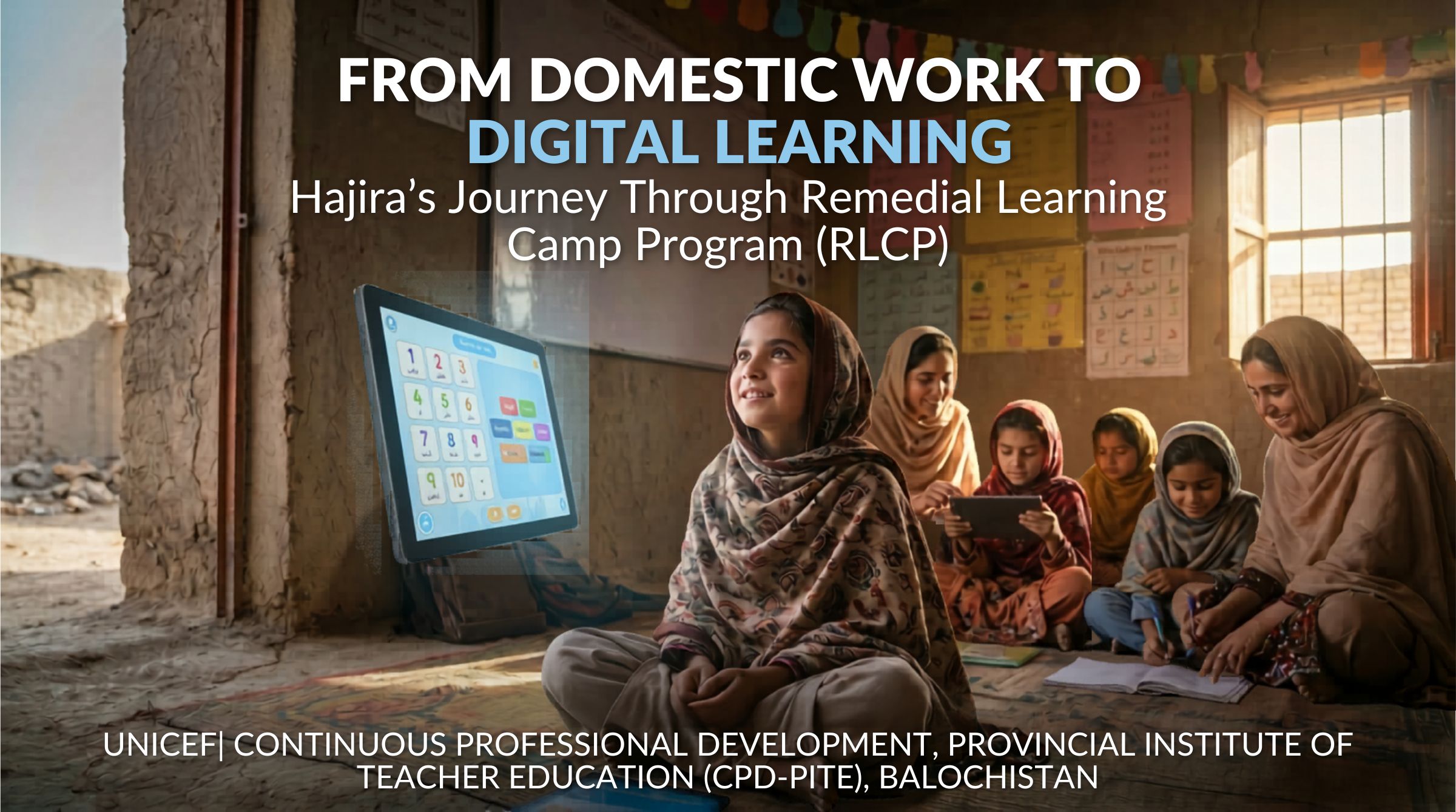
Hajira’s first encounter with the RLCP arose from observation: she noted that girls from her neighbourhood were regularly attending the nearby learning centre, returning with visible enthusiasm and recounting experiences of interactive instruction delivered through digital screens and structured classroom activities. These accounts generated a determination in Hajira to seek access to the Program herself.
Access to the Program: Removing Financial Barriers
Operating under the assumption that education requires financial payment — a perception that is both a product and a reinforcer of educational exclusion — Hajira approached the RLCP learning centre with an offer to provide domestic services to the tutor in lieu of enrolment fees. This interaction underscores the extent to which cost remains a perceived and real barrier to education among the most vulnerable children in the community.
The RLCP tutor responded by clarifying that the Program provides entirely free educational services to all enrolled children, funded through the support of UNICEF and CPD-PITE, Balochistan. Hajira was welcomed into the centre without condition and was immediately supported to begin her learning journey. This interaction is emblematic of the Program’s commitment to unconditional inclusion and its role in dismantling financial barriers that prevent out-of-school children from accessing education.
Learning Progress and Psychosocial Development
Since joining the RLCP centre, Hajira has demonstrated consistent attendance and active engagement in classroom activities. She participates in lessons delivered through a combination of educational videos, structured worksheets, and interactive pedagogical approaches developed under the Program’s instructional framework. Her engagement reflects a growing foundational competency in literacy and numeracy, as well as a marked increase in self-confidence and motivation.
In addition to her regular attendance at the RLCP centre, Hajira voluntarily accesses supplementary academic support in the evenings, demonstrating a level of intrinsic motivation and agency that belies the difficult social and economic circumstances of her daily life. This self-directed commitment to learning represents a significant psychosocial outcome of the Program’s inclusive and supportive learning environment.
Significance for the RLCP and Lessons for Practice
Hajira’s case provides several important programmatic insights. First, it highlights the critical role of community awareness and peer influence in motivating out-of-school children to seek access to learning opportunities. The role of neighbourhood peers in drawing Hajira to the Program reinforces the value of community mobilisation and child-to-child outreach as complementary strategies for enrolment.
Second, the case demonstrates the persistent misconception that education entails financial cost — a barrier that requires active, ongoing communication to overcome, particularly in low-income communities where prior educational exclusion has been the norm. RLCP tutors and field staff play a decisive role in correcting these perceptions and ensuring that eligible children are not deterred from enrolment.
Third, Hajira’s story affirms the capacity of technology-enabled, inclusive learning environments to engage children who have previously had no exposure to formal education. The RLCP’s use of digital content, interactive instructional methods, and structured yet flexible classroom practices has proven effective in sustaining the interest and participation of vulnerable children, including girls from the most marginalised households.
Conclusion
Hajira’s enrolment in and engagement with the Remedial Learning Camp Program exemplifies the Program’s core mandate: to ensure that no child — regardless of economic circumstance, gender, or prior educational history — is denied access to quality foundational learning. Through the RLCP, children such as Hajira are not only acquiring essential literacy and numeracy skills, but are also rebuilding confidence, cultivating aspirations, and reclaiming the right to education that is enshrined as a fundamental entitlement under international human rights frameworks.
UNICEF and CPD-PITE, Balochistan remain committed to sustaining and expanding the reach of the RLCP to ensure that vulnerable children across the province have equitable access to safe, inclusive, and effective learning environments.